Initial enquiry and information
The first contact is usually about understanding what is happening and explaining how mediation could help. There is space to ask questions and to share any concerns about the situation, before any decisions are made.
 National Mediation
When difficult conversations begin to weigh on you, National Mediation offers a calm, professional and trauma-sensitive space — somewhere to think clearly, speak honestly, and decide what comes next, with care.

National Mediation exists because family issues are rarely just legal issues. Their effects are felt throughout everyday life. They touch children, housing, routines, finances, and emotional wellbeing all at once. The pressure of so many overlapping decisions can leave people feeling stuck between wanting to move on and not knowing how to do it without making things worse.
This is where mediation can help. Rather than pushing families further into tension, National Mediation creates the conditions for a calmer kind of conversation. It does not encourage argument. It helps people work out what genuinely needs sorting. It keeps the human side of the situation in view, instead of letting it become cold or distant.
The aim is simple: to support families in finding outcomes with greater clarity and dignity. Adding pressure is the last thing people need when they are already managing uncertainty. They need patience, structure, and an approach that respects their experience.
That is why every part of the service is designed to feel steady, human and responsive — from the very first conversation right through to reaching an agreement that families can live with.
An informal, guided process that helps people talk about family matters and find ways to agree, with the support of a neutral mediator.
Family mediation is most often used when a relationship is ending, when parents need to make arrangements for their children, or when financial questions arise after separation. It can also be helpful when communication has reached a difficult point and direct conversation has stopped working.
A mediator is impartial. Their role is not to judge who is right or wrong. It is to keep the focus steady, hold the conversation in balance, and guide both sides towards practical solutions in a fair and considered way.
Mediation is more flexible than court. It can be shaped around the issues that actually need attention and held at a pace people can manage. Some situations only need one or two sessions to settle a single matter. Others involve several meetings to work carefully through a wider set of topics. The needs of the family help to shape the process.
What sets mediation apart is the tone it establishes. Each person is encouraged to speak openly, but with respect. There is room to explain what really matters. There is also room to listen — which is often where the real progress begins. Family mediation is not about pretending things are simple. It is about handling difficult issues in a more civil, more dignified way.
Mediators do not take sides. They do not push one person into agreeing with the other. They hold the structure of the conversation, keep the focus on the issues that matter, and make space for outcomes both people can live with.
Most people begin with a Mediation Information and Assessment Meeting — a quiet first conversation that takes the pressure off the unknown.
A MIAM is the first step into the process. It is a preparatory meeting where the mediator can explain how mediation works and gain a clearer understanding of the situation. It also gives the person attending a chance to ask questions, voice concerns and consider whether mediation feels like the right way forward.
This meeting is valuable because it removes some of the early uncertainty. Many people know they need to address their family situation but are not yet sure what mediation actually involves, or whether it might suit them. A MIAM offers space to find out, with no pressure to commit.
It is also an opportunity to discuss any practical or personal issues that could affect the process. Common questions include whether mediation can be done online, whether the other person can attend in a separate session, and roughly how long the wider process might take. A MIAM is a comfortable place to explore questions like these openly.
In some situations, attending a MIAM is a required step before certain court applications can begin. In others, it is simply a sensible place to start. Either way, it leaves people more informed and far less anxious about what is to come.
At National Mediation, the MIAM is treated as a meaningful conversation, not a tick-box exercise. It is the moment when people often begin to feel a real sense of agency over what happens next.

A clear, considered process that walks families through each issue without rushing them through it.
The first contact is usually about understanding what is happening and explaining how mediation could help. There is space to ask questions and to share any concerns about the situation, before any decisions are made.
An assessment meeting helps confirm whether mediation is suitable and whether both parties are likely to benefit. It is also where practical details — timing, format, and the issues that matter most — can be discussed properly.
Sessions are arranged in a structured way to focus on specific issues. The mediator guides the conversation so each person can describe what is concerning them and what they would like to see happen, without it becoming overwhelming.
Some families come with a single, clear question. Others need help across several areas at once — living arrangements, time with each parent, school holidays, finances, property. The process flexes to meet what is actually in front of the family.
When common ground is reached, the details can be written up so everyone is clear on what has been decided. This is especially helpful when arrangements need to work in practice over time.
Even when full agreement is not reached straight away, mediation can still be valuable. It often eases tension, improves communication, and identifies the areas that still need attention. For many families, that alone makes whatever comes next feel less daunting.
"The aim is not to make every problem disappear. It is to help families handle them with more clarity, less noise, and a measure of dignity."
Most family decisions are shaped, in some way, around children. Mediation gives parents the space to make those decisions carefully.
Working out arrangements for children after separation is often one of the most difficult conversations a family will have. It carries real emotional weight, because it shapes a child's daily life. National Mediation helps keep these conversations child-focused rather than rooted in old conflict.
Discussions can cover where children will live, how nights are shared between parents, how handovers will work, school holidays, birthdays, and other special occasions. Because so much of this is bound up with routine, security and the rhythm of family life, the conversation can quickly become emotional. Mediation creates the time and structure to consider what is genuinely in the children's interests now, and how that may need to evolve over time.
It also helps parents move past blame and concentrate on the practical questions. That shift matters. Children tend to do better when adults are able to communicate clearly and reach decisions that hold steady from one week to the next.
No two families are the same. Some need help with the basics of scheduling. Others face more layered situations — strained communication, distance between homes, or the careful work of rebuilding trust after a difficult separation. These are the situations where mediation can be especially valuable. The aim stays consistent: to help parents reach arrangements that are realistic, child-focused and workable in everyday life.
Money discussions after separation are rarely just about figures. They carry questions of fairness, security and what comes next.
Separation and divorce bring up some of the most pressing questions a family will face. They involve money, property, savings, debt and future commitments — and they sit alongside everything else that is changing at the same time. For many people, these are among the hardest conversations they will ever need to have.
National Mediation provides a calm setting where these matters can be explored more productively. The goal is straightforward, even when the decisions are not. Mediation helps people work through the practical questions that come with separation: how shared assets might be divided, what happens with the family home, how any ongoing financial arrangements should work, and what is realistically achievable for both sides going forward.
This is particularly helpful when both parties want to keep things as constructive as possible and avoid layering on extra stress. Financial mediation works best when both sides are willing to consider options and the conversation can stay anchored in solutions rather than blame. The mediator's role is to keep that focus, support a balanced exchange, and create a steadier environment for difficult decisions.
For many families, this is a far more manageable path than allowing financial disputes to drift on without resolution. It is not about pretending money is easy. It is about giving the conversation the structure it needs to actually move forward.
Even the right decision can leave behind uncertainty, sadness, practical pressure and difficult conversations. Mediation offers a quieter way through.
Separation rarely affects just one area of life. National Mediation supports people who are trying to find their footing during this time. Some come because they want help navigating a clean, civil split. Others have already separated and need help sorting through the things that still need to be settled. Either way, the process is designed to reduce confusion and help people focus on what comes next.
Issues around divorce often overlap closely with questions about children and finances. That is why a thoughtful mediation service needs to consider the whole picture. It is rarely just one issue in isolation. Decisions tend to influence one another, and they make more sense when they are looked at together rather than one at a time.
Mediation creates the room for that kind of joined-up thinking. Instead of dealing with each problem in a silo, families can work through them more systematically and check that the outcomes hold together. That tends to lead to more stable arrangements and a clearer sense of progress, rather than the feeling of being stuck in a loop of back-and-forth.
For people who want to keep things as civil as possible, National Mediation offers a measured route that supports that goal — one that respects the seriousness of what is happening without making it harder than it already is.

Not every family can comfortably meet in person. Work commitments, childcare, travel, distance and emotional fatigue all play a part. Online mediation offers a more flexible way to take part in the process.
It can be particularly helpful for people in different locations, those with demanding schedules, or anyone who would simply prefer to take part from a familiar environment. It allows mediation to keep moving without adding more pressure to an already difficult situation.
For some families, online support is the difference between starting the process now and letting things drift. And the longer family matters are left unaddressed, the harder they tend to become.
Flexibility matters at National Mediation. People are often managing a great deal at once, and the process should reflect that reality. Online mediation keeps the structure intact while making the service easier to access and use. The format may change, but the substance does not. The conversation stays focused on the issues that matter and on the practical solutions that can follow.
One of the most common questions when someone first considers mediation is what kinds of support might be available. That is entirely understandable. Family matters are challenging enough without confusion about how the process is funded.
National Mediation helps people understand whether legal aid may apply to their situation and whether the mediation voucher scheme could be relevant for them. This part of the process matters because it shapes how someone moves forward and what support might be in place when they do.
The aim is to make the options clear so that people can make better-informed decisions. Clear information leaves people steadier. They know what to expect and feel more anchored in their next steps. As every situation is different, the right approach is always to look at each case carefully rather than assume one rule fits all.
The aim is clarity, not confusion. Families dealing with pressure deserve straightforward support, given in plain language.
Court is formal and outside your control. Mediation is shaped around the family. The difference, for many people, is significant.
Mediation lets people take part directly in the decisions being made. Calmer conversations and practical outcomes tend to follow when people have a real say in what is being agreed.
Court can deepen conflict. Mediation works to reduce it. Disagreements do not vanish, but the process is designed to keep communication possible rather than letting it break down further.
Mediation is more flexible than a strict legal route. That helps when there are children, busy schedules, or emotional considerations to work around.
Perhaps most importantly, mediation gives people room to be heard and respected while addressing sensitive matters. That sense of being part of the process is one of the main reasons families choose it.
National Mediation exists to support that kind of process — a slower, steadier path for anyone who wants to move forward without causing further harm.
Family difficulties do not arrive in a tidy sequence. They tend to land alongside jobs, school runs, caring responsibilities, financial worries, lost sleep and emotional fatigue. National Mediation acknowledges that reality.
The service is built to feel grounded and practical from the very start. People are looking for direction without more noise. They want a process that respects the difficulty of their situation and the limits of their time, with the understanding that life does not pause simply because something has become hard.
Mediation can offer that balance. It is structured enough to make progress yet flexible enough for real life to keep happening alongside it. It provides enough direction to keep the process on track and enough room for people to be active participants in shaping it.
People rarely come to mediation because everything is going smoothly. They come because they are under pressure and need a clearer path through. That is why tone, pace and support matter so much.
A first conversation is often more about reassurance than information. People want to know how it works, and whether it might be right for them.
The early stage is usually about understanding the situation and talking through how to approach it. It gives a clear, calm starting point. Around that, there is space for the practical detail of the issues involved.
The conversation is held respectfully and in an orderly way. Each step should feel intentional rather than rushed. Questions are welcomed. Concerns can be raised. Nothing about the process is meant to feel hidden or hard to follow.
Most of all, the aim is to help people feel a little more prepared for what comes next. The process itself should never make difficult issues more confusing than they already are.
National Mediation aims to provide that kind of stability. The whole service is built to help families communicate, think and decide more clearly, even when life feels especially uncertain.
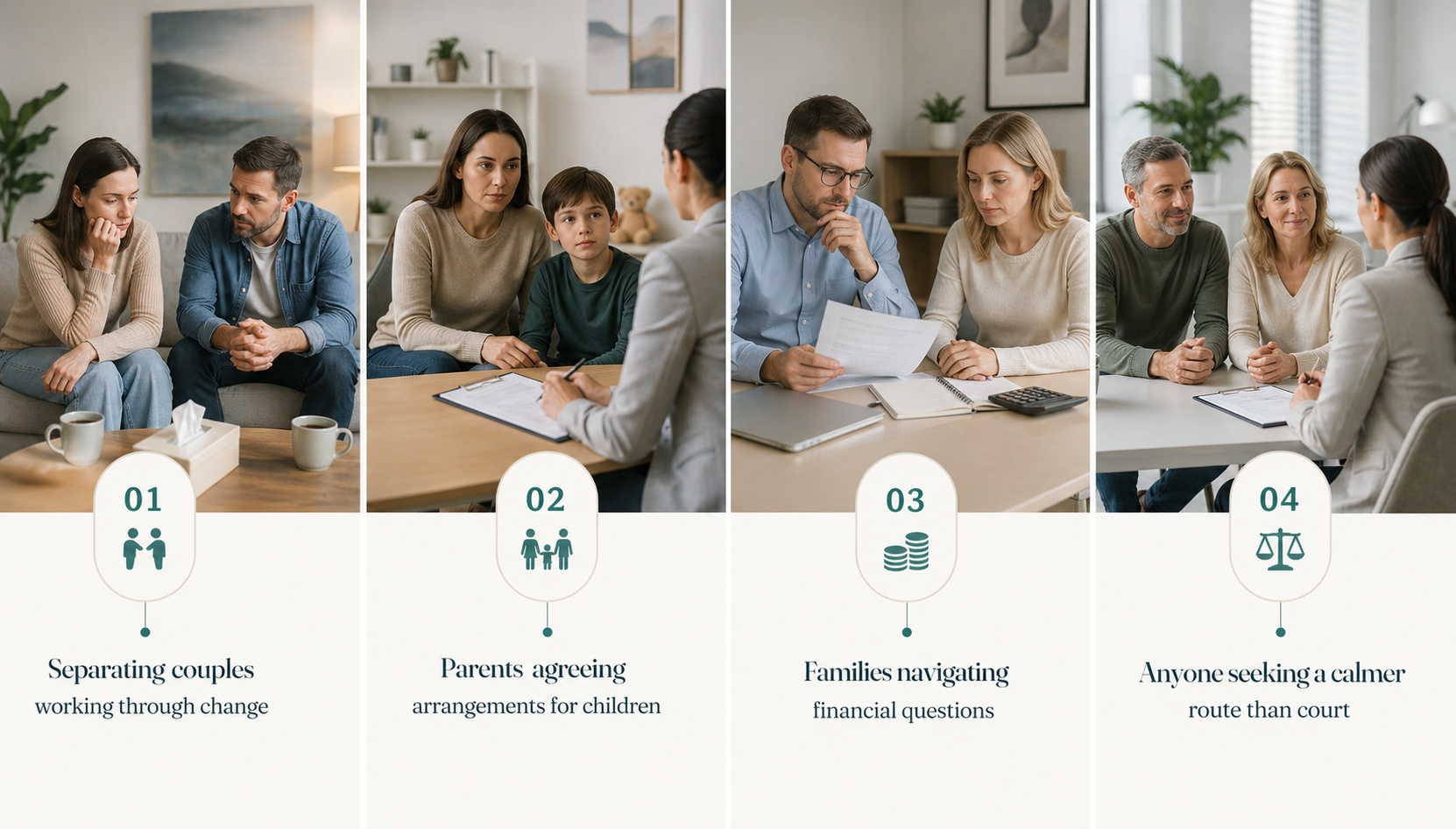
Mediation is for the moments when a calmer, more practical conversation could quiet a difficult situation.
Family mediation can support a wide range of people and situations. It can help separated couples working through issues with children, housing or money. It can be valuable for parents who want to repair communication. It is often a better option for those trying to avoid a long and exhausting court process. It can also help when direct conversation has become too difficult and a neutral space is needed.
Some people come to mediation early, before any conflict has had time to harden. Others come later, after attempts to handle things directly have become frustrating. Both situations can still benefit from the structure mediation provides.
It is also for those who simply want a less combative process. Not every family wants a fight when things break down. Mediation offers an alternative to that — one that prioritises understanding and practical thinking over winning a position.
One of the most useful things about mediation is that it takes place in a neutral environment. Family discussions held at home or by message can become emotional very quickly, with little real progress. People interrupt each other. Old grievances resurface. Important points get lost in the noise.
A neutral space changes that dynamic. It allows everyone to communicate more clearly and to think with greater care. It keeps the focus on solutions rather than on the heat of disagreement. It also relieves some of the pressure of trying to manage these conversations alone, without support.
A neutral context does not solve every problem on its own. But it often makes real progress possible. When the conversation is steered calmly, clearer thinking becomes available. That, fundamentally, is what National Mediation provides — a setting where the conditions for genuine progress are protected from the start.
Even when adults work hard to minimise tension, separation has an effect on children. They notice changes in routine. They sense stress. Even when little has been said directly, they often carry quiet worry about what is happening around them.
This is why mediation focused on child arrangements can be so important. It is not only about getting the schedule right. It is about putting together a thoughtful, stable arrangement that helps the child move through their daily life with less disruption.
When parents can talk these matters through calmly, the resulting decisions tend to be more practical and more consistent. That consistency gives children a sense of security at a time when so much else may feel uncertain.
This is the broader perspective National Mediation works to keep in view. The focus stays on what children need now, and on what will help them through the transition with as little upheaval as possible.
Money matters after separation, but it is also an emotional topic. Discussions can raise questions about fairness, shelter, future stability and the strain of starting over. That is why financial mediation needs both caution and clarity.
National Mediation creates space for these conversations while recognising how serious they are. The process helps people work through the available options together and move towards arrangements that make sense for each side.
Discussions might touch on the family home, income, current obligations or wider financial responsibilities. The goal is a conversation with enough structure to be useful, but enough flexibility to handle the complexity of real life. For many families, this approach causes far less long-term strain than allowing a financial dispute to grind on unresolved.
One of the hardest aspects of family change is that it can feel urgent in the worst possible moments. People can feel pushed into decisions while they are still emotionally drained. Mediation helps ease that pressure.
It does not delay progress for the sake of slowing things down. It simply makes room for better decisions. When emotions are still raw, that pause can change the quality of the outcome significantly.
Some people need time to think things through. Others are ready to focus quickly on the key issues. The process can reflect either. It is not designed to be rigid. That kind of flexibility is something National Mediation values, because it keeps people genuinely engaged in the process rather than feeling pushed through it.
When a family is under strain, communication often becomes sharp, defensive or evasive. People stop listening properly. Each person stands up to defend their position, and every conversation can begin to feel like a confrontation.
Mediation helps reset that dynamic. It does so by giving the conversation a more respectful framework. People are encouraged to speak clearly without being cut off or escalated against. The mediator's role is to keep the dialogue stable and gently bring the focus back when it drifts.
This kind of communication matters because, often, the way people speak to each other is just as important as the decisions being made. National Mediation places real weight on this. A calmer conversation tends to produce clearer agreements and far less collateral damage along the way.

When families feel stuck, every option can start to look like another wall. Mediation offers a different route. It is not always easy, but it is often genuinely constructive.
Instead of arguing about issues, it helps people work to resolve them. It encourages practical thinking. It draws attention forward, towards what can be done, rather than dwelling on what has not worked. That is why people choose mediation when they are dealing with separation, parenting questions or financial disagreements. It offers guidance without taking choice away from them.
National Mediation is here to help that next step feel steadier and more measured.
The intent of National Mediation is straightforward — to help families work through complex issues in a way that makes life more manageable, more practical and less damaging. That can include child arrangements, financial questions and broader matters connected to separation.
No. Mediation can still work even when communication between the parties is strained. The whole point of the process is to create the right conditions for a useful conversation, even when direct talking has become difficult.
The first stage is usually a MIAM. It is an opportunity to explain the situation, understand the process and assess whether mediation is likely to be a good fit for the people involved.
Yes. Many families need help with both. Mediation can address them in a joined-up way, recognising that decisions in one area often affect the other.
Online mediation is particularly useful for people who need more flexibility or who cannot easily attend in person. It can make it easier to take part without having to rearrange the rest of life.
Not always. The early assessment is so important precisely because every situation is different. The aim is to make sure the approach is appropriate and safe for everyone involved.
No. Mediation is not about conceding or giving in. It is about discussing problems in a way that may produce better outcomes for everyone, rather than letting them harden into ongoing conflict.
In many cases, yes. Mediation helps families find workable solutions for their particular circumstances without going through the full court process, although every situation is considered on its own terms.
National Mediation helps people understand whether legal aid may be relevant and whether the mediation voucher scheme could apply. It varies by situation and is reviewed individually.
The hardest part is often simply making the first move. People feel uncertain, tired or apprehensive about what comes next. That is entirely understandable.
National Mediation exists to make that first step feel less overwhelming. You do not need to know everything before you begin. You do not need to have the whole picture clear in your mind. All that is needed is somewhere sensible to start.
Mediation offers exactly that. It gives families a place to talk through what matters with the right structure, the right support and a clear sense of purpose. It can ease pressure, deepen understanding and help people move forward in a way that is more solid than scattered.
For anyone navigating separation, important parenting decisions, financial questions or a difficult breakdown in communication, National Mediation offers a thoughtful and constructive way forward. When life is in upheaval, a steady conversation can change everything.